
Hancock County Bench Warrants Explained
A bench warrant is a judge's command to bring someone back before the court. It almost always grows from a case that already exists. Missed appearances are the classic trigger. Ignoring some other court order can produce one too. The document exists to enforce the court's authority and put the matter back on the calendar. In Hancock County, public sources lean on the plain phrases "bench warrant" and "failure to appear." The labels "capias" and "capias pro fine" do not show up as the standard local wording. That distinction matters when you read a docket, so rely on the actual entries rather than assumptions. When the language is unclear, ask the court what the entry means for your case.
Hancock Missed-Hearing Timeline
The chronological case summary often reads like a story: hearing set, notice sent, failure to appear, warrant ordered, later action. Timing varies by judge and case. A Hancock County absence does not always produce a warrant on the spot. And a newly scheduled hearing, by itself, does not prove the warrant has been recalled.
- Locate the scheduled hearing and notice entries.
- Read the docket for a failure-to-appear finding.
- Identify the warrant issuance date and issuing judge.
- Check later entries for service, recall, quash, or a new hearing.
- Confirm the latest order with the assigned court.
A cause number is essential. The Hancock Clerk's filing page warns that submissions without one can be rejected, so locate it in MyCase before contacting staff or filing anything.
How Hancock County Bench Warrants Are Issued
Indiana courts may issue an arrest warrant after a defendant skips a court date in response to a summons. In Hancock County, the judge alone controls that call. The clerk records the order, and law enforcement handles service. That split matters. The clerk cannot cancel a warrant at the counter, and no police department can promise a judicial recall. Which judge to contact depends on case assignment. Under local rule LR30-CR2.2-1, Superior Court II takes infractions, ordinance violations, misdemeanors, and Level 6 felonies. Circuit Court and Superior Court I divide the other felony work. No Hancock municipal or town court appears in the current Odyssey list.
Indiana Hearing Text Reminders
Indiana runs a text reminder system that can help. The Indiana judicial reminder system notifies eligible subscribers five days and one day before a hearing. The state warns plainly that a missed appearance may result in an arrest warrant. Reminders lower the odds of a problem, but they change nothing legally. They do not excuse an absence, alter a court order, or replace the official notice in a case. A Hancock County reader should treat them as a convenience, not a shield.
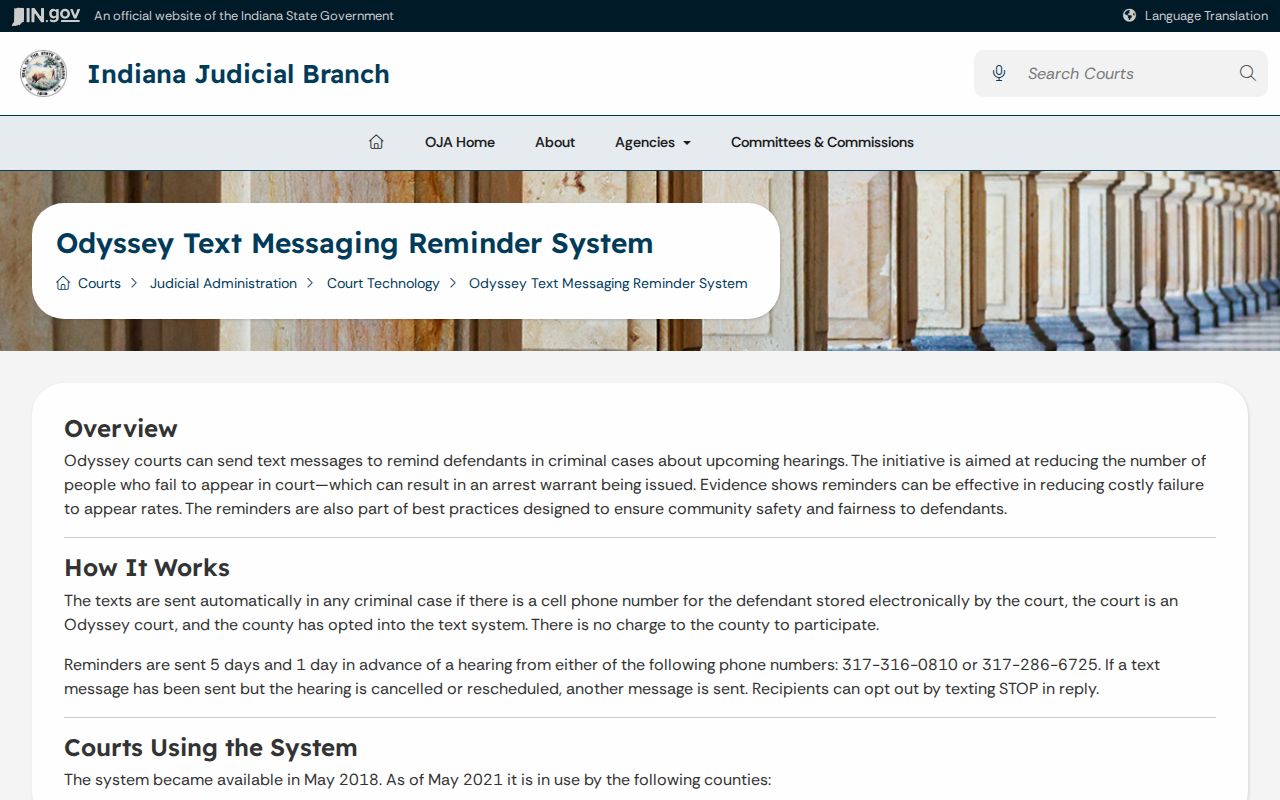
The lesson for Hancock County drivers and defendants is simple. Keep contact details current, read every notice, and call the court before a setting you cannot make.
Bench and Arrest Warrants Compared
Bench warrants and arrest warrants both can put a person in custody. They arise differently. A bench warrant normally follows conduct inside an existing case, like a missed date. An arrest warrant generally follows a sworn showing tied to an alleged offense. A summons sits apart. It orders an appearance without directing an arrest, though ignoring it can bring a warrant. In Hancock County, the label on the paper matters less than the latest order. Check whether the process is still live before acting.
| Process | Typical trigger | Best record source |
|---|---|---|
| Bench warrant | Missed hearing or disobeyed order | Existing case docket and issuing court |
| Arrest warrant | Probable-cause finding on an alleged crime | Criminal case and issuing court |
| Summons | Order to attend court | Case docket and served notice |
Labels matter less than the latest Hancock County court order. Verify with the court that the process is not still live.
Hancock Superior II Bench Route
A missed date on an ordinance, traffic, misdemeanor, or Level 6 felony matter often lands in Hancock Superior Court II. Call 317-477-1115, or visit 9 E Main Street, Room 217, Greenfield. Before calling, search MyCase by citation or cause number and select that court. Read the hearing and warrant events first.
Local distinction: Greenfield, McCordsville, Fortville, and New Palestine do not have separate current municipal courts in the Odyssey list. Their lower-level Hancock cases route through county court.
Cumberland needs a second look. Court code 49I01 marks a Marion/Cumberland Town Court case. A Marion-side matter never belongs at Hancock Superior II just because the address says Cumberland.
Resolving a Hancock County Bench Warrant
Resolution starts inside the issuing case. An attorney can ask about a new hearing, a surrender plan, bond, or a motion to recall or quash. A judge decides. No payment, police call, or records request removes a Hancock County warrant by itself.
Call before appearing. A live warrant can be served at a courthouse or jail. Ask the court or an Indiana attorney how to proceed safely.
Hancock County local rules also cover remote appearances. File such a request seven days before a hearing when reasonably possible. That step can help with a future setting. It does not cure a missed date or recall an existing warrant.
Finding the Court That Issued the Warrant
Open MyCase and copy the full cause number; the court segment identifies the division, and the case page names the court and judge. In Hancock County, Circuit Court answers at 317-477-1107. Superior Court I uses 317-477-1148. Superior Court II uses 317-477-1115.
Hancock County Clerk Public Access
9 E Main Street, Room 213
Greenfield, IN 46140
317-477-1109
Hancock County Sheriff
398 Malcolm Grass Way
Greenfield, IN 46140
317-477-1147
In Hancock County, the clerk supplies the file, the court rules on it, and the sheriff handles service and law-enforcement records.
Hancock Bench Warrant Record Fields
A bench-warrant trail can include the party, cause number, court, case type, hearing, failure-to-appear entry, warrant issuance, bond order, service return, and later recall. Not every document sits online. The Hancock County docket still gives you a map for a focused request.
| Cause number | The stable case identifier. |
|---|---|
| Missed setting | Date and kind of hearing the court expected. |
| Warrant order | Date, judge, and terms shown in the docket. |
| Bond | Amount or conditions set by the court, if public. |
| Service return | Law-enforcement report about execution. |
| Recall or quash | Later judicial action that changes status. |
Ask for the specific order, not "all records." Indiana's reasonable-particularity rule helps staff in Hancock County locate the right item fast.
Hancock County Bond and Recall
Hancock County judges set bond, and the amount is what the kiosk can take. The Hancock jail's own instructions send approved payments to the lobby ATM kiosk or JailATM, with a $5 criminal-case bond fee on top. Cash-bond rules also warn that named costs and fees may be kept before any balance comes back, so a full refund is never guaranteed. Posting money is not the same as recalling a warrant. Call the jail at 317-477-1158 to confirm bond terms, then check the warrant status with the court. If no payable amount has been set, the kiosk cannot invent one. An attorney can separate posting bond in Hancock County from asking the judge to withdraw the bench warrant outright.
Hancock Bench Record Access
Indiana MyCase is a handy lookup, but it is not a full criminal-history report. Sealed cases, juvenile matters, excluded personal data, and other confidential material may not show up. Court files follow the Indiana Rules on Access to Court Records; public-agency records fall under the Indiana Access to Public Records Act instead. In Hancock County, the Clerk Public Access Department takes requests in person, by mail, or by fax. Copies run $1 per page, and certification adds $3. Include the cause number, court, date, and event. Staff cannot give legal advice, yet a precise request can still establish whether a public recall order or warrant entry exists in the Hancock County record.